In the last entry, I wrote about the moment I stopped looking at AI as another tool.
That was really the turning point for SEnuke AI.
I started thinking about what would happen if software didn't just wait for us to tell it what to do.
What if it could understand the business first?
What if it could look at where you are, where you're trying to go, what opportunities exist, what isn't working and what should probably happen next?
Then build the strategy.
Help execute it.
Measure what happened.
Learn from it.
And do it again.
That thinking eventually led us to what we're building today:
The AI Growth Operating System.
At the time, it was simply where I believed AI was going.
But something interesting has been happening since then.
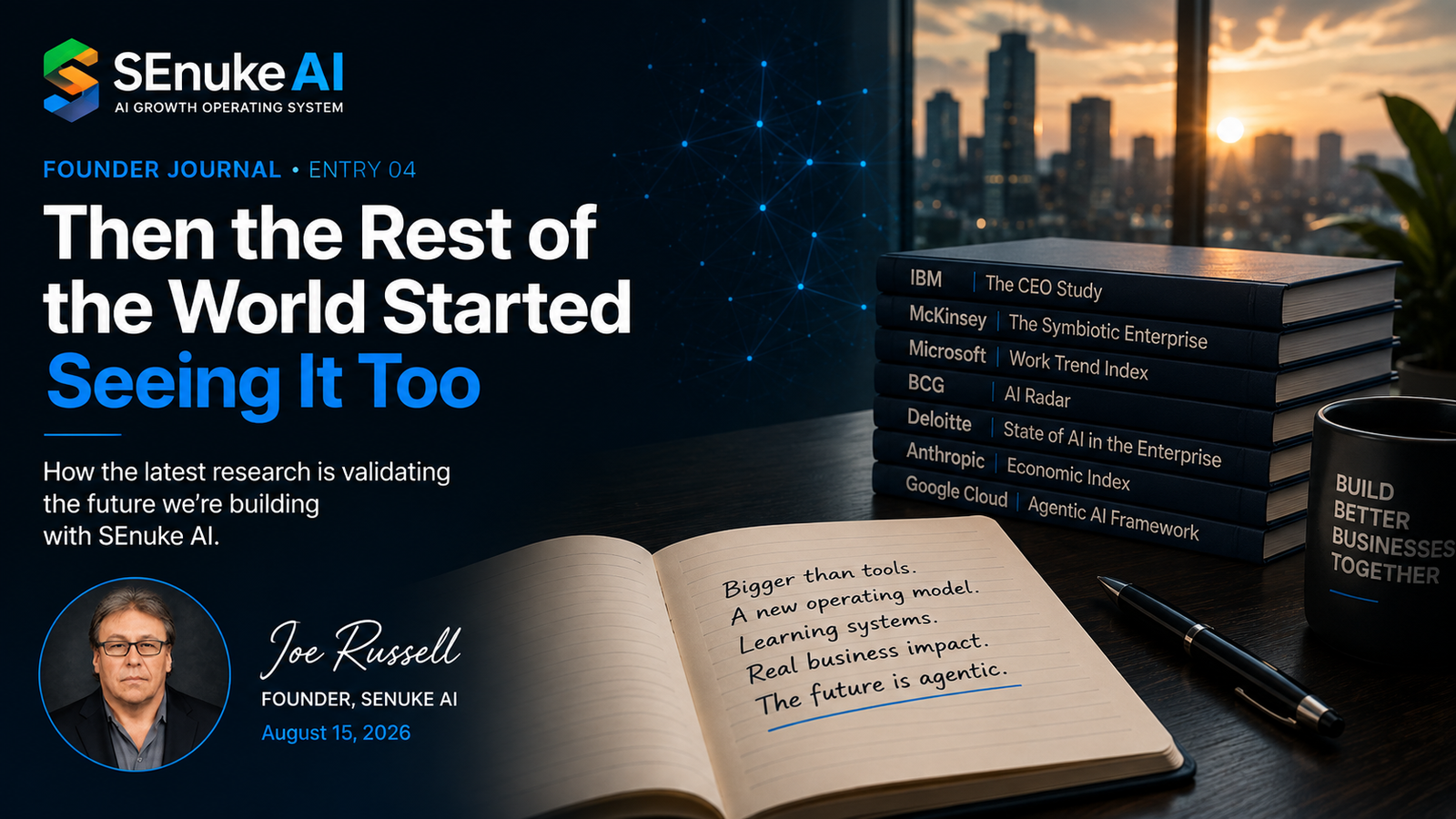
Some of the biggest technology companies and research firms in the world have started describing a future that sounds remarkably similar.
AI is moving beyond the chatbot
For the last few years, most people's experience with AI has been pretty simple.
You ask.
It answers.
You prompt.
It creates.
Then agents came along and started taking that a step further.
Give the AI an objective and let it perform a task.
But the research coming out now suggests we're moving beyond even that.
IBM is talking about AI becoming part of the operating model of the business—not simply another technology layer.
McKinsey is describing AI as moving beyond a tool and becoming part of the workforce.
Anthropic's own usage data shows people moving away from simple conversations with AI toward longer-running agentic work.
BCG is seeing leading companies move toward AI systems built around their own priorities, context and decision-making.
And Microsoft recently used a phrase that really caught my attention:
“Every firm is a Learning System.”
Their research describes organizations capturing what worked, what failed and what changed, then using that intelligence to improve what happens next.
When I read that, I smiled.
Because that is almost exactly the problem we've been trying to solve.
The real breakthrough isn't that AI can do more
I think that's where a lot of the conversation about AI still gets stuck.
Which model is smarter?
Which one writes better?
Which one generates better images?
How many agents can we create?
Those things matter.
But I don't think they're the biggest change.
The bigger change is what happens when intelligence becomes connected to the entire process.
Understand.
Discover.
Strategize.
Approve.
Execute.
Measure.
Learn.
Then determine the Next Best Action.
And repeat.
That's very different from opening an AI application and asking it what you should do today.
It's also very different from assembling twenty AI tools and calling that an AI platform.
The intelligence has to understand what happened before.
It has to understand what you're trying to accomplish.
And everything needs to work together.
That's why we call it an operating system
When we started using the term AI Growth Operating System, it wasn't because we needed another marketing phrase.
We needed a way to describe what we were actually building.
An operating system isn't a collection of disconnected tools.
It's the intelligence that connects what the business knows, what it should do, what gets executed and what happens next.
That's the distinction.
And the more research I read, the more convinced I become that this is where AI is heading.
Not just more generation.
Not just better chatbots.
Not just agents waiting for another objective.
But intelligent systems that understand context, coordinate work, measure outcomes and continuously learn.
The enterprise world is approaching this from the perspective of enormous organizations.
We're approaching it from another direction.
What if that kind of intelligence could be put in the hands of an entrepreneur, a growing business or an agency?
That's the opportunity that excites me.
We didn't change direction because of these reports
I want to make that clear.
We didn't read a Microsoft report and decide SEnuke AI should become a learning system.
We didn't read IBM and suddenly decide to call this an operating system.
The architecture was already taking shape.
The Continuous Growth Loop was already part of what we were building.
Business understanding, opportunity discovery, strategy, approval, execution, measurement, learning and Next Best Action were already connected.
That's what makes these reports so interesting to me.
They aren't telling us what to build.
They're giving me more confidence that the direction we chose was the right one.
And I think we're still early.
The next generation of AI won't wait for you to figure everything out
That's ultimately where I believe this is going.
The first generation of AI answered questions.
Then it started creating things.
Now we're watching it begin to perform work.
The next step is intelligence that understands enough context to help determine what work should be done in the first place.
That's a much bigger change.
And for business growth, that's exactly what we've been building toward.
There is still a lot I haven't shown you yet.
That's going to change quickly as we get closer to launch.
But if you've been wondering why I keep saying SEnuke AI isn't another command-based AI application, this is why.
We're not trying to build another place where you sit in front of an empty box and figure out what to ask.
We're trying to build something that understands enough about your business to help figure out what should happen next.
And increasingly, it looks like we're not the only ones who believe that's where AI is going.
— Joe Russell
Founder, SEnuke
SEnuke AI publicly launches September 8, 2026.